

Look who's talking
Is the AI wearables arms race just one big act of ASMR?

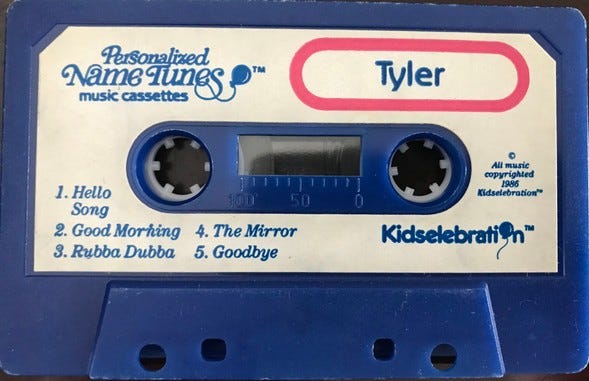
As a kid who grew up in the nineties, I was the proud owner of a special blue cassette emblazoned with my first name. Made by a company called Kidselebration, the tape contained five tracks of personalized, motivational children’s music, from opening banger “Hello To A Special Person” to closer “Goodbye, It’s Been Quite A Treat.”
I must have played that thing every single morning for years, even though the songs were simple and repetitive—and even though its 29-minute run time was actually just 14.5 minutes of the same music twice. I couldn’t get enough of hearing how I was “Jonathan, a special boy,” and how I’d do things that day like wake up, bathe, and go to sleep. I’m even pretty sure that staring at the monogrammed cassette was how I learned to spell and write my own name.
Objectively—and I can admit this now—there was nothing that special about Kidselebration, nor about me. The music wasn’t synergistic with Raffi or Sesame Street; it wasn’t tied to a big kids’ movie of the day. It was just the work of handful of anonymous singers, songwriters, and producers1, and it’s now available for about $20 on eBay.
But here’s the thing: The singers on that tape sang my name 23 times.2 They could have known me as well as my parents, friends, or relatives. They gave me something that felt like it was just for me, and which put me in a trance the moment the reels spun.
Fast forward to 2026, and customized wearables and devices are the last frontier between how we currently experience life (i.e., with our own eyes) and how Silicon Valley envisions life for us (i.e., filtered through their influence). Wearables in particular have been an oddly slow-moving sector, with Apple doing such a good job making the iPhone an omni-tool that really only health trackers3 have been able to break new ground as far as tech we use to manage our everyday lives.
And yet Meta continues doggedly to thrust its smartglasses, well, right in front of our faces. 2025 was a banner year for the tech; the 7 million pairs sold more than doubled the prior two years combined, leading to forecasts that 100 million will sell by 2030. Now, after experimenting with ad strategies ranging from the initial “everyone will want these” (turns out no, not exactly) to “let’s just cut the price” ($800 down to $299), Meta’s going all in on a strange combination of AI and ASMR.
The AI part of this equation is obvious: Meta Glasses are, per Meta, “the most natural and seamless way to access an AI assistant in your daily life.” If AI is now the accepted shortcut to figuring out the world, glasses are an even shorter cut to just saying something and making it real, hands-free. (Neural implantation, still thankfully a science fiction, might one day be the thing that allows us to merely think something into existence.4)
The ASMR part is a bit harder to parse, but it goes something like this: A big push behind the latest Meta Glasses is that they put famous people in your ear, which is somewhere on the spectrum of cool/fun, comforting, and outright parasocial.
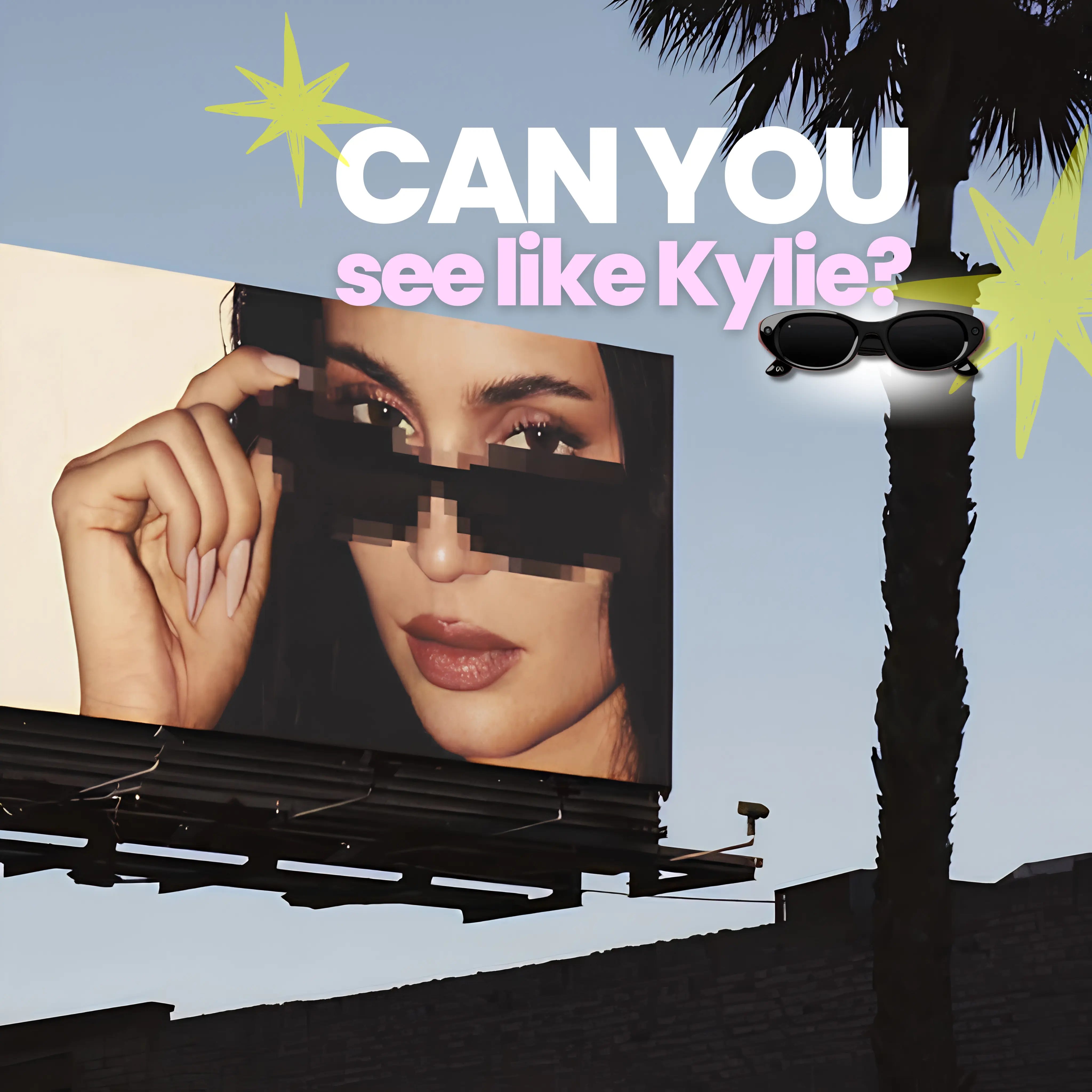
Everyone knows that Kylie Jenner, for instance, can now be your smartglasses voice, a strategic choice by Meta given its history of privacy violations, particularly against women.5 (It’s perhaps ironic that someone who’s made a career marketing beauty products and monetizing her own image is somehow meant to be interpreted as a marker of security for women; all the same, Jenner is obviously defensible as a hugely successful businessperson, and is maybe the most recognizable face, if not voice, on the planet.)
But did you know that Judi Dench, Kristen Bell, John Cena, Awkwafina, or Keegan-Michael Key can also be the sound within your glasses? That’s an interesting cross-section of celebrity6, and maybe more than anything represents a canny play by all of them to become universal, omniscient voices—a tech-fueled (and possibly quite lucrative) take on the way Morgan Freeman sounds to everyone like God.
The play by Meta, meanwhile, in a move distinctly opposite Her-esque pixies like Siri and Alexa, is to deliver an experience already somewhat familiar to us, quickly make it personalized, and at some point thereafter obfuscate our ability to distinguish between what we want in general versus what we want just because Dame Judi Dench whispered it in our ear.
Autonomous sensory meridian response (ASMR7), the delightful tingling that can accompany gentle stimuli, is thus kind of the goal here. If a wearable could first enable and then endlessly repeat this exact braingasm feeling, which has been attributed to sources as distinct as Bob Ross’s painting and videos of people blowing up water toys, it could tap into an industry that’s sitting at 65 billion annual video downloads as of 2024—just a few short years after first breaking into the Top 5 in YouTube search terms in 2020.
ASMR is also a key to unlocking both our reward and emotional arousal centers, meaning we’ll sit through mundane or unpleasurable experiences if ASMR is attached to them, or we’ll assign additional pleasure to already-pleasurable experiences if ASMR is attached to them. (I’m not sure I’ve ever personally experienced ASMR, but if I have, it’s been from customer service calls with a lot of soft keyboard typing and hold music. A few bars alone of Opus No. 1 can put me in the mood. Of course, I’m not alone; there’s a Reddit all about this.)
An extremely powerful psychological coup is therefore at hand: Not one that gives us actually coherent AI, like good recommendations for things we might ask smartglasses about—the best nearby bakery, walking directions to get there—but rather to pull us into an unending lull of talking to the robot in our midst about anything and everything. As it so often goes with tech, the crux isn’t the quality of info, but the addictiveness of the experience—and ASMR, an unlock code to comfort and anti-scrutiny, is a perfect foil for how wearables have become a symbol (and reality) of “surveillance capitalism dreck.” By the same token, the use of celebrities—whom we still trust, even in this day and age, as endorsers, more so when they’re attractive—might override how little faith we put in tech companies. (The phrase “lipstick on a pig” comes to mind.)
Still, can it really be so easy to improve a questionably marketable product with an insanely marketable mascot, and suddenly make a pair of smartglasses akin to an iPhone? Why haven’t all our chatbots, who certainly engage in sycophantism and other forms of flattery, started talking with sensuous voices?8
One issue might be credibility: Seduced as we are by AI’s promise of flattening all the world’s queries into an instantly winnable game of Jeopardy!, we still might balk at Kylie Jenner (or equally, John Cena) being believably know-it-all. (And Ken Jennings unfortunately lacks sex appeal.)
This reminds me of how someone I know defaulted their Waze navigation to being read aloud in Roger Federer’s voice, a deeply strange collaboration where computerized Fed ends up saying things like, “Make a U-turn…hey, even champions can mess up.” It took all of a few hours of driving in their car for me to start to loathe Roger Federer (of all people!), in part because he started repeating his catchphrases, in part because it dawned on me that Roger Federer isn’t in any way a logical choice for driving directions. (An F1 star might have made more sense.)
Another problem might simply be a confusion of intended purpose: Are AI glasses fashion? Are they supposed to be a computer? Are they your friend? Successful wearables tend to be defiantly single-purpose—think of step-counters and sleep-scorers—as opposed to jackknives, and even when things are jackknives, they’re typically concealable, discreet, and only used for one thing at a time.
This is especially why I think product managers at Meta are laser-focused on the experience of their glasses, not the content. Think of flipping the classic quote, often attributed to Maya Angelou—“People will forget what you said, people will forget what you did, but people will never forget how you made them feel”—on its head: The sentiment there is usually about doing good and being good in the world, a more virtuous purpose than merely collecting achievements. But from the perspective of ASMR-fueled wearables, it might be interpreted thusly: Don’t worry if you’re delivering subpar content via those chunky spectacles; just make sure you’re engaging the spine tingle in whoever’s wearing them.
And last, as this tech continues to grow, a bit of bad news for nearly half the population (not to mention a limitation on AI companies building it): Apparently, only about 60% of us are able to experience ASMR in the first place. The same way only about 72 choices were available on those pre-millennial Kidselebration cassette tapes—when you had to have a popular-enough name to get in on the action—you’ll need to be prone to ASMR to ever undergo the technofeudal future fever dream of highly enjoyable everyday eyeglass computing.
And if so…lucky you?
Credit where credit is due: The Kidselebration crew was comprised voice-over artists Anthony Giarratano, Merri Struhl, Francine Sama, Nikki Ryder & Fran Eckert; songwriter Michael Rosenbaum; and producers Peter Roth and Lisa Ratner.
Lucky me that my name was even included in the Kidselebration universe, which only catered to about 72 first names (tending toward biblical Americanized names; no dice for today’s Ryders or Hudsons). You couldn’t even get a one-off tape cut back then; you had to write the company to petition for them to record a new version. This, three decades ago, was the level of customization we were at.
By the way, do health trackers work? One study said it’s impossible to really measure (maybe that’s purposeful on the part of their sellers). And then there are all the opinions on how they might make us more healthy, but certainly make us more anxious.
Meta, in fact, is playing the neural translation game too; their tech is called Brain2Qwerty, an AI that “sits outside your skull, reads the magnetic fields your brain fires as you type, and rebuilds sentences from brain waves…with best volunteer hit [rate of] 78% word accuracy.”
Per Gizmodo, some issues with Meta Glasses thus far: “At least one case of extortion; someone used smartglasses to record sex workers without their knowledge; even the Ray-Ban Meta owners themselves were swept up in a privacy scandal when an investigation revealed that the company was sending some photos and videos taken with the smartglasses to human contractors who train Meta’s AI.”
Google, for its part, also made the early and horrible decision to allow you to take photos with your Google Glasses by winking, a “winkshot.” Its glasses were pulled from the market after two years due to “high cost, privacy concerns, and public confusion about [their] purpose.”
On the other end of the spectrum—i.e., celebrities taking action not to cash in on the AI voice dupe wave, but to avoid being ripped off by it—we have both Taylor Swift and the Backstreet Boys working fastidiously to trademark their voices and images.
Technically speaking, the feeling of ASMR is paresthesia, a “sensation of the skin that may feel like numbness, tingling, pricking, chilling, or burning.” ASMR is generally pleasant, though other forms of paresthesia include when your arm/leg falls asleep, or when you hit your funny bone.
OpenAI famously did put a voice on a chatbot, one that sounded eerily similar to Scarlett Johansson. And after she had turned Sam Altman down to voice the product. Which is to say, not a good look.