

Squares, rectangles and speculation
On LeBron, Chuck Schwab, and the distinction between gambling and investing

The time-honored one-way rule in math states that all squares are rectangles, but not all rectangles are squares. It’s certainly a little squishy, since at the point when a rectangle “becomes” a square (i.e., when it has four equal-length sides), it kind of just is, in fact, a square. Nonetheless, it’s technically accurate that every single square on earth is also a rectangle.
It’s a bit of a leap from there into personal finance, but stick with me—since the same rule can be applied to gambling and investing. As in: All investing is technically gambling, but not all gambling is investing. More to the point, the versions of “gambling” as recognized by society—online sports-betting, prediction markets1, lotto tickets, slot machines—are never investing, though the well-oiled machines behind them are doing an amazing job convincing us they are. And as the legalization2 of all of these things removes, perhaps, their stigma, it enables their insidious effect on the wallets and livelihoods of an increasingly alarming number of Americans. (More on that later.)

Investing, meanwhile, deserves its rightful examination against the textbook definition of gambling, largely because the line between the two is fundamentally blurred. That definition: Gambling requires placing stakes (an initial value) on a random event with the intent of winning something more (a potential and deferred value), and without any overarching strategy. At a quick glance, investing fits the bill—though many people, especially those who take what might be deemed the “correct” approach to long-term investing—would argue a few things:
A relatively stable, historic-data-rich stock fund does not constitute a random event.3 Certainly it’s true that an index fund is less random than a wagered event like who’s going to score first in a basketball game. But it’s also valid that the only reason the stock market seems non-random, and can be expected to grow in value over time, is because of all our data on it.4 I find it hard to see why sports, where we also have tons of historical data, is significantly different here. (You can even see how Jalen Brunson having an amazing performance and winning an NBA game, a supposedly “random” sports feat, has similar impact to Elon Musk tweeting something that moves markets.)
Long-term stock market investing—putting money in at regular intervals and leaving it to grow across decades—constitutes a clear and present strategy. Sure, but this mentality can again be applied equally to some sports outcomes. Take baseball, the most famously mathematized sport, where you can use sabermetrics to try and understand, for instance, the likelihood that a player might get a hit, or multiple hits, in a game—and then bet on that outcome. (Ironically, baseball is also among the sports where underdogs win most frequently, making it a bad sport, strategically, for gambling on favorites.) The NYT meanwhile called prediction market specialists “sharps” in a very good piece a few months back, noting how they’ve made millions by “figuring out what other people don’t yet know…[spending h]ours scouring public voter data, building financial models and even contacting professors, journalists and actual Wall Street analysts to get a leg up.” If that’s not strategy, I’m not sure what is.
Gambling is marked by being short-term; investing is long-term. Maybe traditionally this is true; today, not so much. Plays like parlays, as well as contracting on prediction markets, draw out the process and reward cycle for wagers; Kalshi has a market for “Peak US National Debt Under Trump Administration” that won’t resolve for years. On the other hand, day trading, whether done professionally or at home, has made short-term investing altogether common.
An NIH paper comparing gambling, speculation, and investing makes this observation: “Gambling differs from investment on many different attributes and should be seen as conceptually distinct…[but e]mpirically, gamblers, investors, and speculators have similar cognitive, motivational, and personality attributes.” And Investopedia says that “investing and gambling both involve risking capital in the hopes of making a profit.” It argues that investors have access to more predictive data than gamblers, but admits countless commonalities between the two.
All to say, for sake either of ease or argument: Investing is gambling. Done right, it is the most long-term successful and safest form of gambling, but it’s a form of gambling nonetheless. And this statement has value not due to technicality, but because, semantically and socially, it might actually benefit all the people losing hordes of money to “traditional” gambling to understand that there’s something else they could be doing—slow-and-steady stock investing—that might scratch, in some way, that same gambler’s itch, but actually stand a chance at providing a long-term reward.
Still, the status quo is that people don’t think of investing as gambling. They think of it as boring, as something your parents might tell you to do. DraftKings boasts Kevin Hart and LeBron James as ambassadors; Charles Schwab has some guy named Carl.5 Crypto Arena hosts the Lakers, and Charles Schwab—to pick on them again—has a field that hosts the Creighton University Bluejays. In the zeitgeist, investing suffers dramatically from its association with age and retirement (think regular use of golf clubs)—which allows plenty of room for shiny prospects like sports betting and prediction markets to slip in and flaunt their elusive short-term upsides. And the problem is, all of this has real costs.
Research just published from Brigham Young University surveyed nearly 200,000 homes, and found that 11% of them housed a problem gambler—someone betting more than 5% of his or her monthly income gambling, and averaging about $1,100 per quarter on such wagers. Those problem gamblers cut their brokerage investments by 50% in order to gamble more, to the tune of about $220 per quarter. They more frequently appeared in low-income households, and their presence did not reduce overall household spending—meaning gambling is most likely an additional family expense, not a replacement for other necessities or entertainments6 (although it can, as aforementioned, replace savings behaviors).

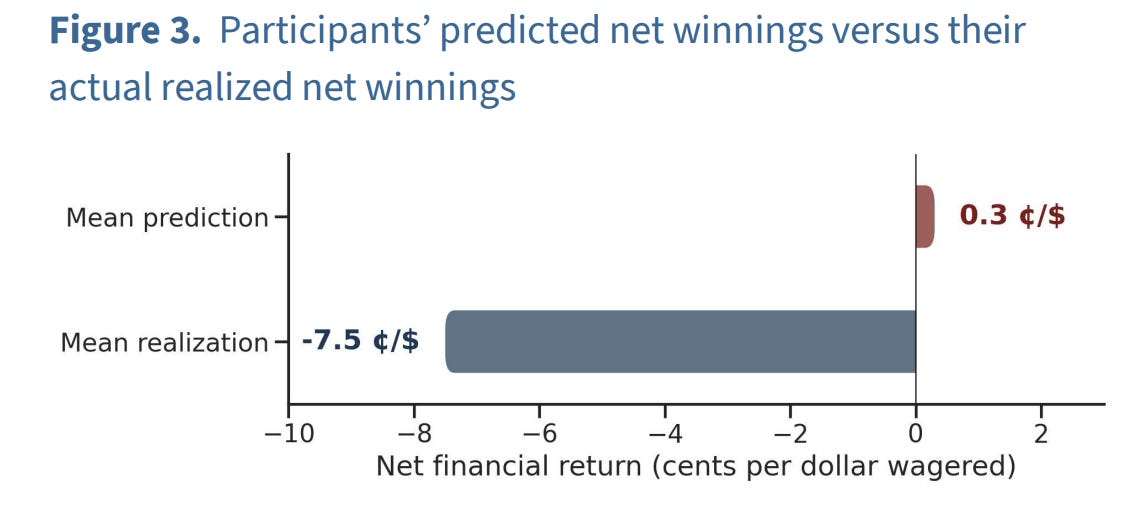
The reason this is so concerning is that this gambled money simply doesn’t fare well. UCSD tracked 700,000 sports gamblers across 32 states from 2018 to 2023, and less than 5% of them withdrew more money from their gambling apps than they deposited. (To say that a different way: About 96% of those 700,000 gamblers lost money.) And Stanford found that bettors lose an average of 7.5 cents per dollar wagered, concluding thusly: “We find that people are overoptimistic about their future chances of winning and internalize virtually none of their losses.”
So let’s run some numbers: $1,100 gambled per quarter over twenty years is $88,000 either lost or stagnant. If we meanwhile only take the $220 per quarter that the aforementioned frequent bettors are no longer putting in the stock market, that amount ($880/year) would grow to $36,000 (at 7%) in those same two decades. (And by the way, it will: An analysis of more than a century of the stock market shows that if you invest in the S&P for 15 years, your chances of making money are 99.8%.)
So these folks aren’t just losing the money they’re gambling; they’re missing out on money they’d be earning. That’s a quietly two-pronged wallet shrink lurking beneath sporadic stories of landed parlays, crypto bull runs, and prediction market scores, and it compounds with deeper social and financial fractures: See studies showing that gambling more increases domestic abuse, or that personal bankruptcies climb by roughly 25% when states allow online wagering.
The thing is, we’re actually on the precipice of something really great when it comes to investing. While the average baby boomer made their first investment at 31, the average Gen Zer did so at 20. That ten year shave can be monumental; note the classic case of how saving $1,000 per year at 20, then stopping at age 30 until age 65 (total invested = $10K), will lead to more money than saving $1,000 per year from age 30 to 65 (total invested = $35K). But at the same time, 69% of Gen Z gambles versus 57% of boomers, and that’s just the tip of a trend that will worsen as sports betting and prediction markets further legalize, advertise, and physically locate themselves everywhere and anywhere. Already, we're in an environment where a third of bettors describe gambling as an investment strategy, and where the Oracle himself says that the media frenzy around the S&P and IPOs is breeding gamblers, not investors.
If we advocate in this moment for the exact opposite—naming investing as gambling, even if it has its arguable differences—maybe investing can capture back some of the cachet currently hogged by all these money-losing behaviors. Diversification can be a sort of parlay; being “in the know,” as goes the sales pitch for so many failed cryptocurrencies and Kalshi hacks, can be the terminology applied to long-hold index fund strategies; dollar-cost averaging can hold a level-up status akin to positive expected value gambling. And most simply and importantly, people can make money again, as long as they’re willing to wait. And as long as they can divorce themselves financially from Mets and Jets scores, or whether a human will land on Mars before California starts high-speed rail.
Prediction markets are not technically gambling, but that’s more of a legal and structural phenomenon than anything else. Culturally, they might as well be gambling.
The numbers on gambling legalization: The US Supreme Court reversed the federal ban on sports gambling in 2018, and American wagers increased from $57.6 billion to $167 billion between 2021 and 2025.
On randomness, fascinating stuff here from Persi Diaconis at Stanford—a magician who became a professor. In “Dynamical Bias in the Coin Toss,” he observes that a coin flip is actually not a random event, but a physical one; and that you can manipulate said event to more likely produce your intended outcome. (For instance, a coin more often lands on the side it’s flipped from than not.) All to say, the most famous “random event” isn’t even really random.
In fact, as analyzed here before, any individual year’s stock market returns can be expected to be all over the place.
To be fair, traditional investing has had its share of interesting mascots, chief among them the E-Trade baby, a nice torch-carrying of the internet’s love of overly animatronic infants.
In fact, states that legalize gambling see an increase in consumer spending on restaurants, alcohol, and cable services, i.e. expenditures adjacent to watching live sports. The frequent bettors in the BYU study spent $270 more per quarter on such items.
It would be grand if you could get compulsive gamblers to check into the markets. A great idea. How can you effectuate that change in mentality? That’s the rub. The immediate payout for the gambler is king.